

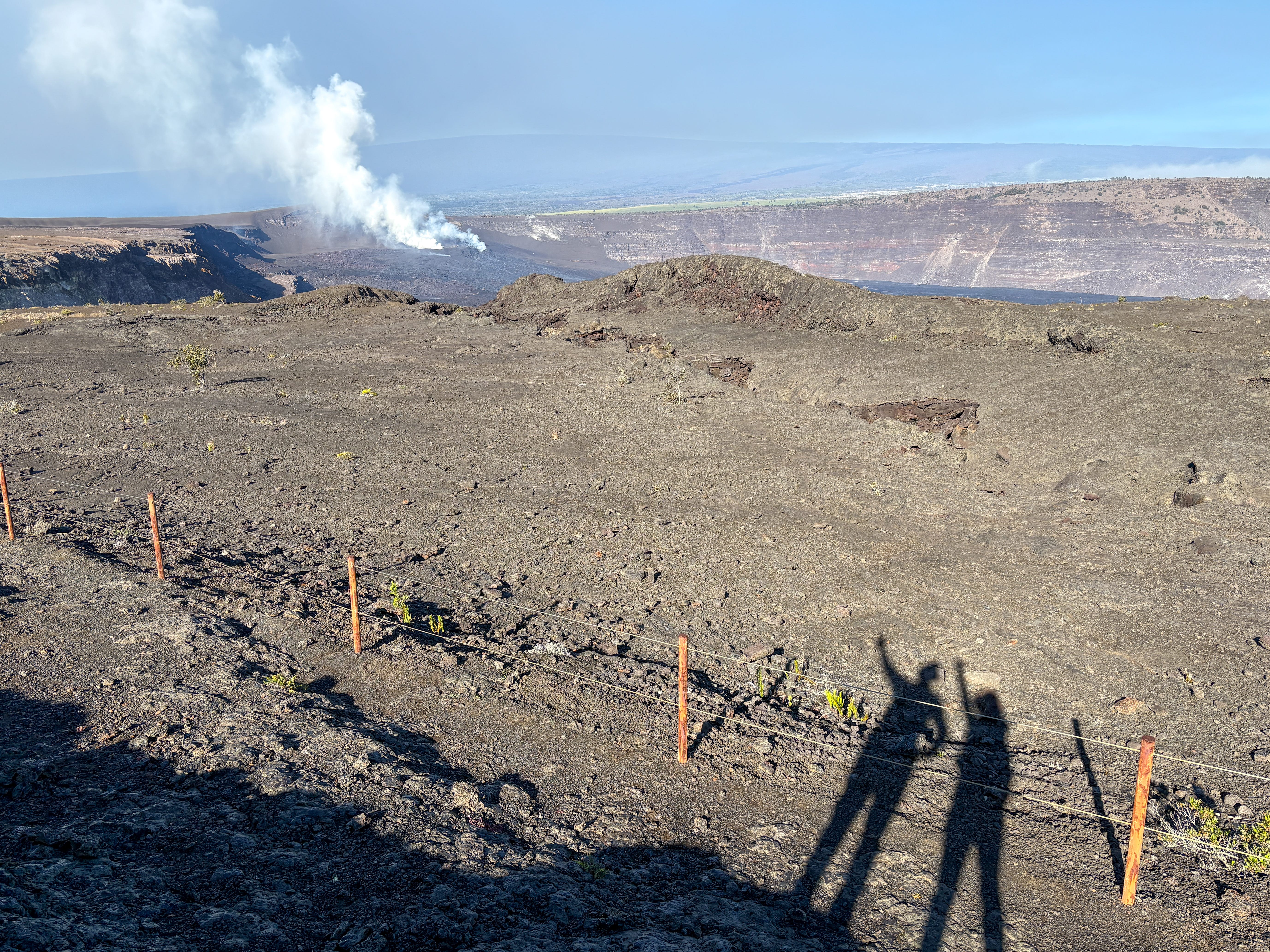
Every December, I go to Maryland with my husband. Usually, we stay with his parents for a few weeks, then return before the end of the year to spend the New Year’s festivities at home in Tokyo. That has been the general plan for roughly two decades. This year, however, we broke with tradition and spent all of January in the States. The reason being that I needed to have “boots on the ground” to promote the release of my new book there. But then my husband was invited to give a keynote to a group of Japanese educators… in Waikiki.
Waikiki! We’d already bought our tickets to Dulles, but this was too fun of an opportunity to turn down. He was excited to speak to teachers, as his own language senseis had changed the direction of his life. But it meant flying from Tokyo to Washington D.C., then three-quarters of the way back to Honolulu, within the space of about a week. Would that halve our jetlag or double it? And then there was the huge gap in terms of climate, from below freezing in Maryland to the balmy mid-seventies in Waikiki. I looked at our suitcases skeptically, wondering how we’d fit multiple seasons worth of clothing in. The distances, the logistics… It was totally crazy. But it was also Hawaii. So of course we were all in.
And really, given how packed my schedule had been the last few months, a vacation sounded just about right. I’d spend some much-needed time on the beach while my husband did his conference, and then we added three nights to let us explore the Big Island. The first we’d spend at a resort in Hilo, then move to a bungalow just outside Volcanoes National Park. My idea was to take a leisurely tour of the Big Island while hiking around Mt. Kilauea.

But life had other plans in store.
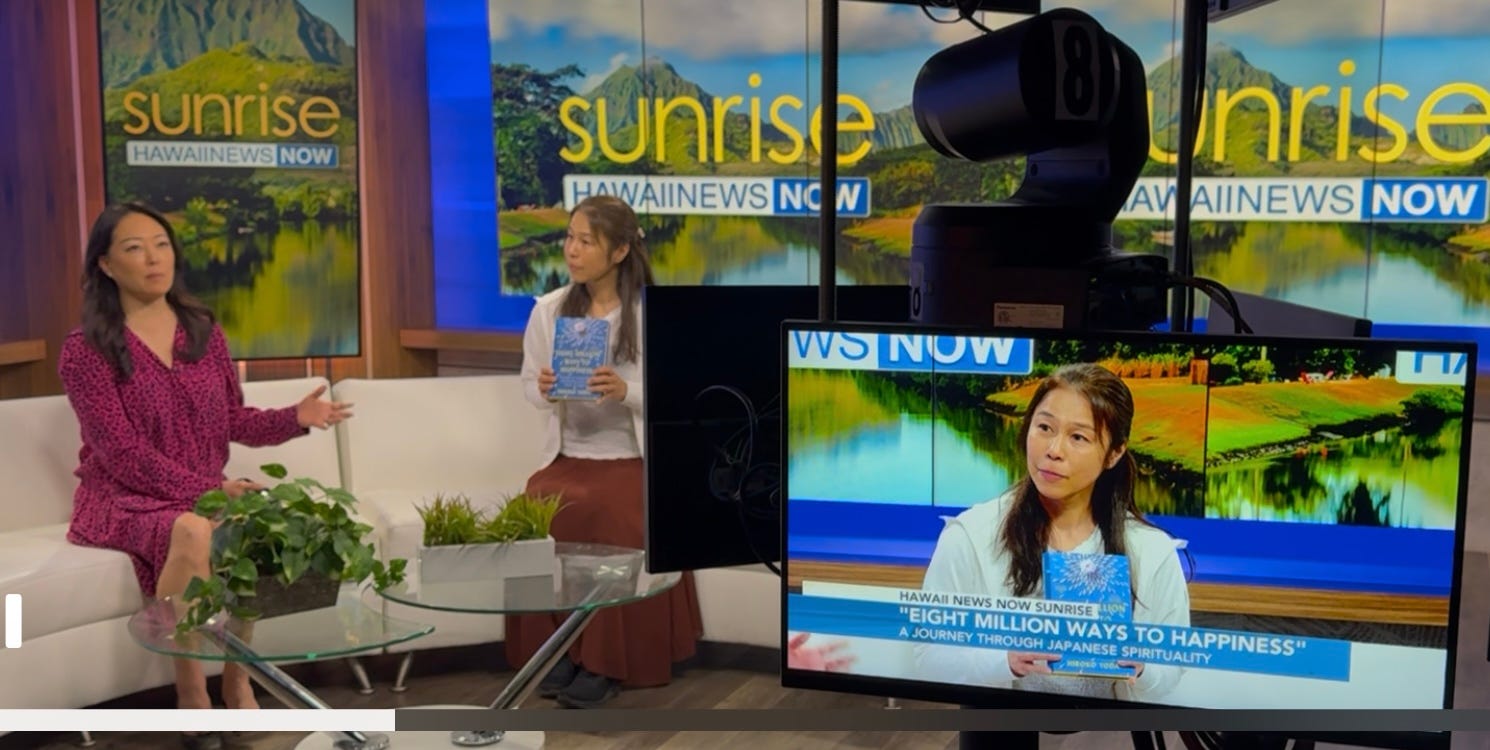
Things took an unexpected turn while we were still in flight. When I woke up, a few hours before landing, my husband informed me that he’d been exchanging emails with an old friend in Hawaii, and she’d just arranged an appearance for me on Hawaii’s biggest morning news show the very next day. All I had to do was hop in her car the next morning. So instead of sleeping in, I found myself in Hawaii News Now’s “Sunrise” Honolulu studio talking about my book on live television at six in the morning.
My “vacation” kicked off with that unexpected excitement. And as it turned out, it ended with an equally unexpected thrill: we just so happened to be in Volcanoes National Park when Mount Kilauea erupted on the morning of January 12th. Now, I should note, as a Japanese native, volcanoes familiar to us. In fact there are well over a hundred active in our country today. But Japan’s are stratovolcanoes. When they get active, they can explode. So when we hear word of an impending eruption, we run.
Not so in Hawaii. Its shield volcanoes behave quite differently from the ones in my country. They tend to slowly ooze magma or spray it upwards in fountains, like some kind of insanely large firework. Locals keenly track these events, of course, because even slow-moving lava can be incredibly destructive. But other eruptions, more contained, with little potential for damage, are magnificent natural shows.
I learned this on our first day in Hilo. The big-screen televisions in the lobby bar were set to the feeds of various US Geological Service livecams placed inside Kilauea’s caldera. So were the various displays in common areas and hallways. Here on the Big Island, it seemed, volcano watching was a kind of sport.
After settling in we sidled up to the bar. I ordered a mocktail; My husband took a Mai Tai. On the screens, a pair of rocky vents percolated bubbles of magma. It was a strange sight, as though an invisible giant were fluffing enormous, glowing pillows.
“Doming out pretty good right now,” said the bartender, catching our gaze. Then he turned to another couple sitting across the bar, who’d just flown in from Honolulu in an effort to catch an eruption. We overheard that the USGS was predicting one any day now. Kilauea went dormant for long periods, but had grown active again in December of 2024, fountaining in numerous eruptions – officially called “episodes” – over the course of 2025. Now we were due for what the volcanologists were calling Episode 40.
It was all anyone seemed to talk about. “Look at the previous episodes! It’s gonna be this week for sure,” I overheard another man telling his friend, in the same tone a bookie might use to handicapping the horse races. Watching the vents burbling on screen, I could understand. When we talk about geology we usually think about timescales that boggle the human mind. But here geology seemed to be on a kind of speed-run, happening in the blink of an eye.
“If it fountains anything like it did last month,” the bartender told us as he cleared our drinks, “it will be unbelievable. The magma went over a thousand feet last time.” Then he gave us details about where to park in Volcanoes to get closest to the “action.” The Park Service kept visitors at a safe distance, but there were several prime viewing spots. They had limited parking spaces. And if Kilauea erupted, he said, you could bet half the island would make a beeline for the park. Many locals went their whole lives without catching sight of a fountain, unpredictable as eruptions were.
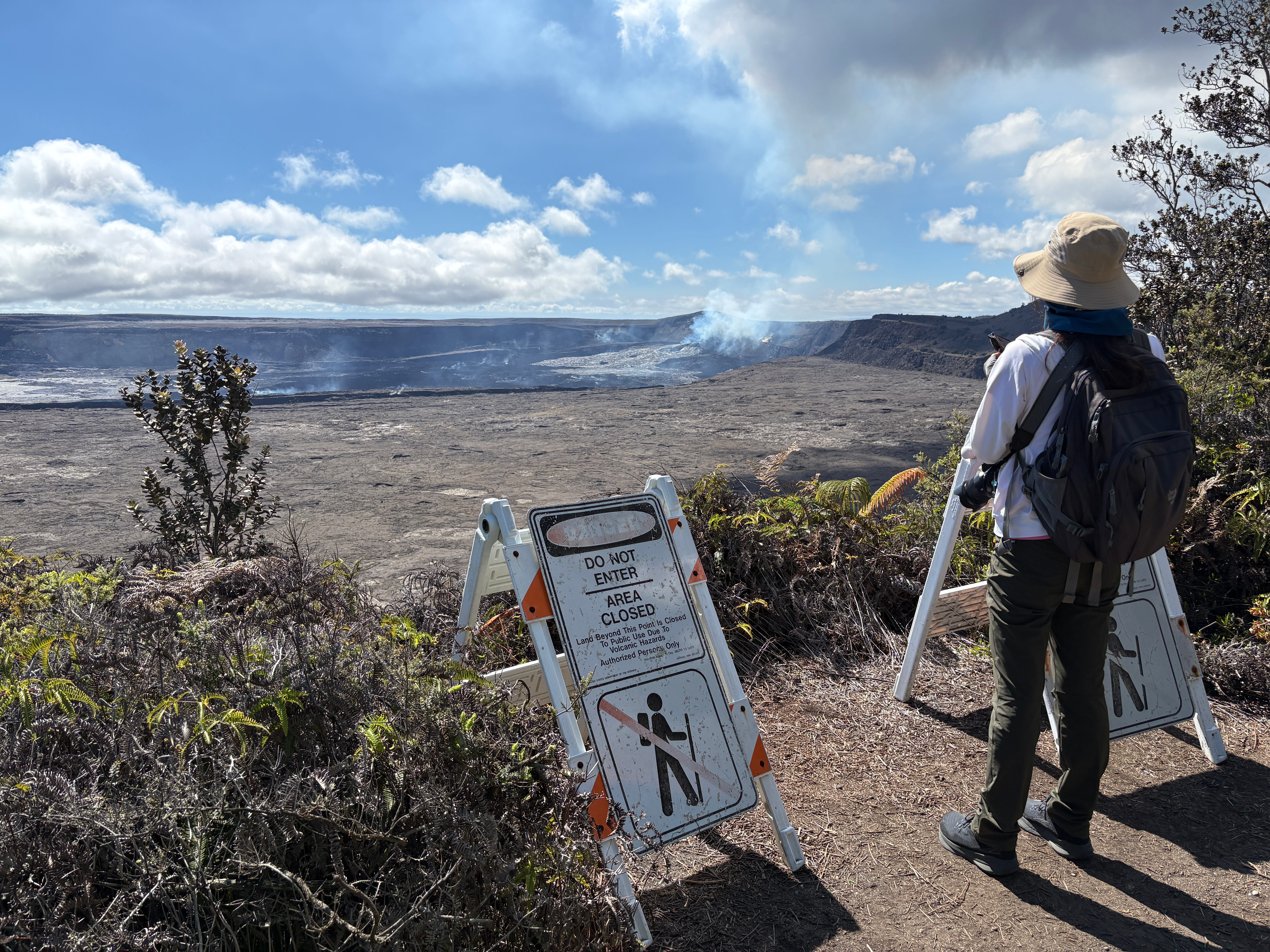
We drove to Volcanoes National Park early in the morning of the next day. The first thing that struck me was the sheer size of the mountains on the island. They were tall – Mauna Kea stood 4,207 meters, slightly taller than Mount Fuji, but also more voluminous: its base was double or more Fuji’s width, giving the mass a grade so gentle it seemed to become the horizon. Mount Kilauea, the centerpiece of the park, wasn’t as high, but its caldera was huge, more like a giant meteor crater than the peak of a mountain, its lip a sheer 165 meter cliff. Off in the distance we spotted the two vents we’d seen on camera, now steaming mightily. We began to hike the rim to get closer to them.
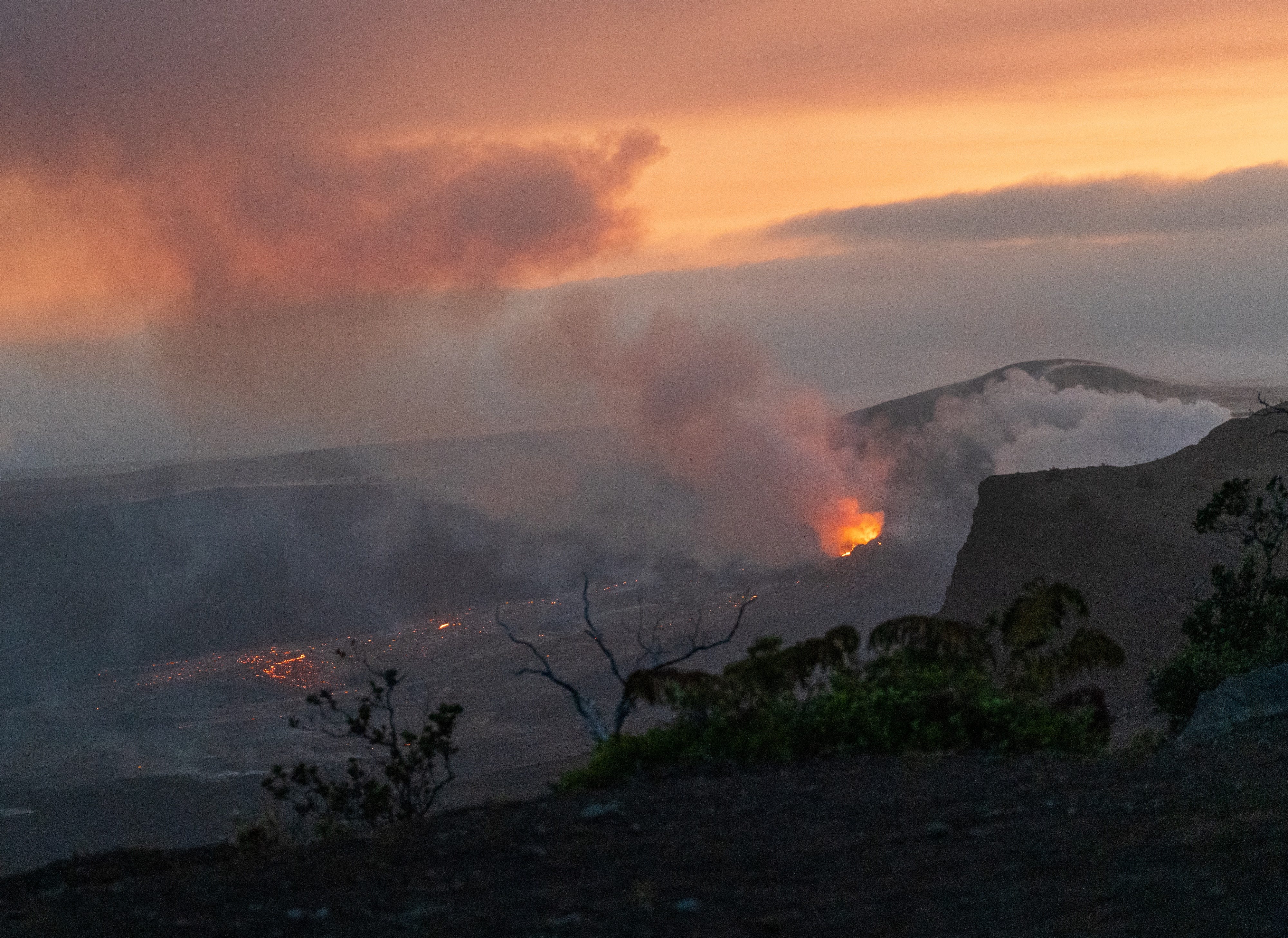
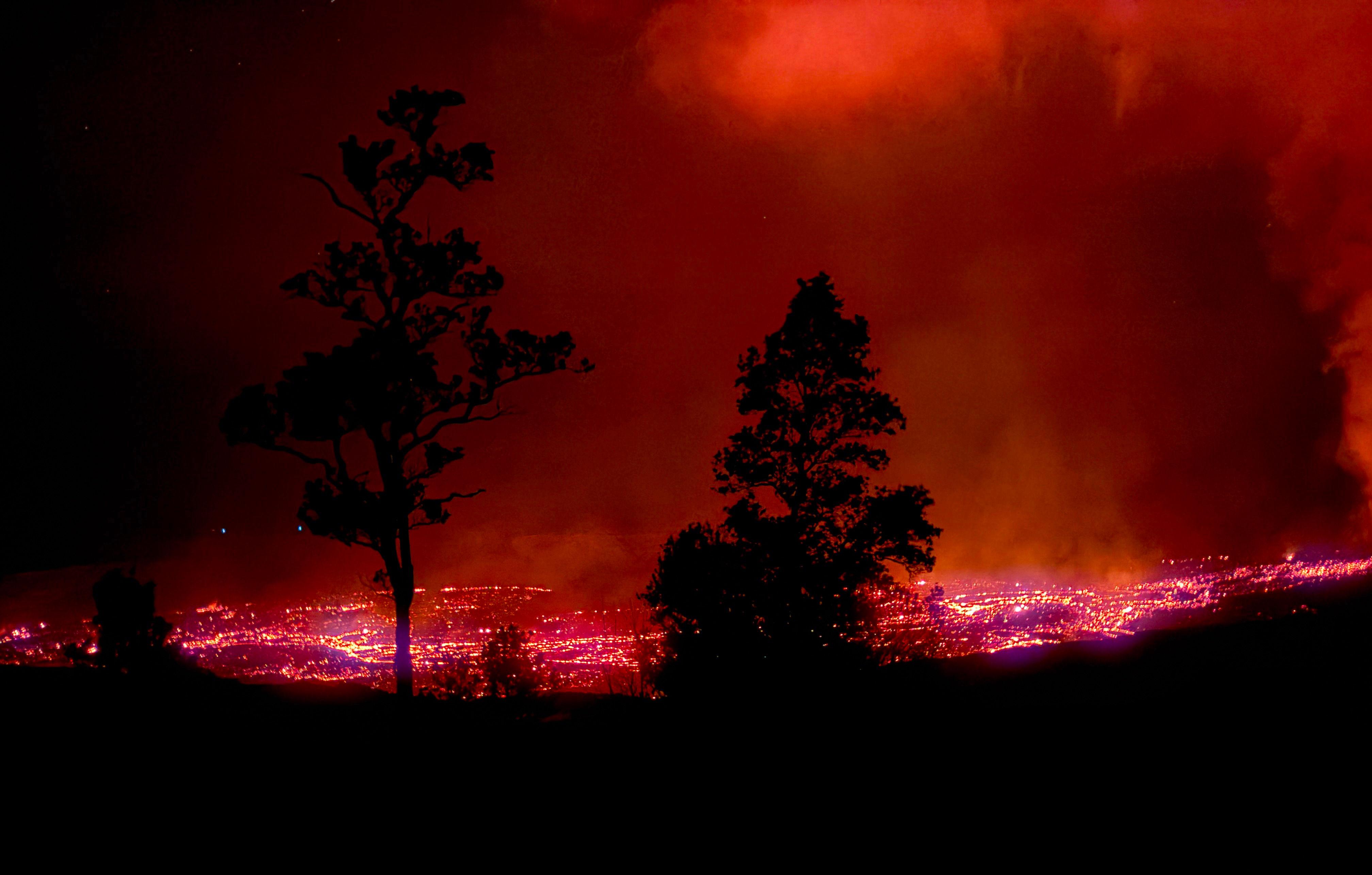
We ended up spending all day there. As night fell, incandescent rivulets of lava stained the skies pinkish-red, in a scene that reminded me of Mordor from the Lord of the Rings.
The next morning, my husband and I awoke at five thirty, thanks to jetlag. We puttered about eating breakfast and getting ready, the TV in our room tuned to the USGS live-feed all the while. At around seven, my husband motioned me over. The vent had been “doming.” Now a flood of molten lava was gushing from it as well. Was this “it?” The great thing about staying where we were was that we could jump in our car and be at the crater ten minutes later. Which is exactly what we did. We had big plans to visit all of the sights in the park, but knew we should take a look at the vents first.
Shortly after we arrived, the doming grew more energetic, eventually developing into a little fountain – “little” only because we were two kilometers distant; it undoubtedly dwarfed the size of our house. The blue sky contrasted beautifully against the luminescent red lava and the jet-black terrain of the caldera. What a day! I thought. But then something changed. The fountain began to grow larger, slowly at first, then faster, spewing a bright red liquid that I could scarcely believe was stone high into the sky. “This is it!” we said excitedly to one another. And it was. Episode 40 reached heights of 800 feet – five times the height of Niagra Falls! – with the show lasting from eight A.M to a little after six P.M., as though the volcano had decided to put in some human hours at the “office.”
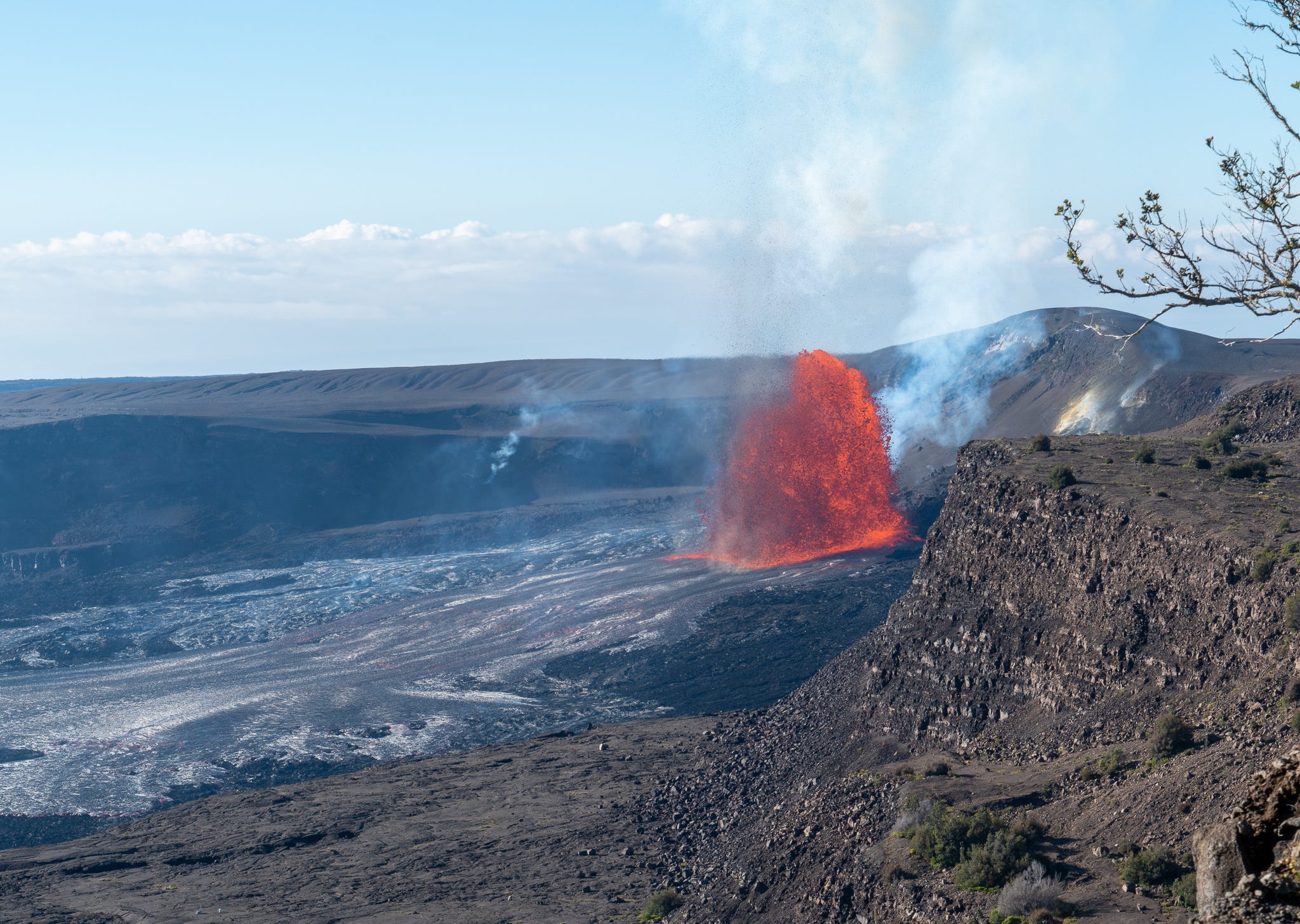
[Make sure your sound is on! Feel the power of Mount Kilauea.]
For those eight hours, we did nothing but watch. The fountaining of the vent; the relentless creep of magma coating the floor of the massive basin below in a lake of liquid stone. Later we’d learn that some 5.5 million cubic meters of lava spewed out of the Earth over the course of the day, at volumes of nearly 200 cubic meters a second. That is very roughly equivalent to the average amount of water that goes over Niagara Falls every half hour.
According to Hawaiian legend, Kilauea is home to a female deity named Pele. She is the goddess of fire and lighting and volcanoes, beautiful and passionate, easily angered, and prone to burning those who invite her pique. Yet locals love her because she is an avatar of nature, beautiful and fearsome. Kilauea is both a natural monument to her, and an embodiment of her. This reminds me of the kami, the spiritual beings of my home country. Kami more than symbolize nature; they are nature. A feeling of awe towards natural phenomena is one of the most fundamental aspects of Japanese spirituality. And those feelings are closely connected to our ability to appreciate its beauty.
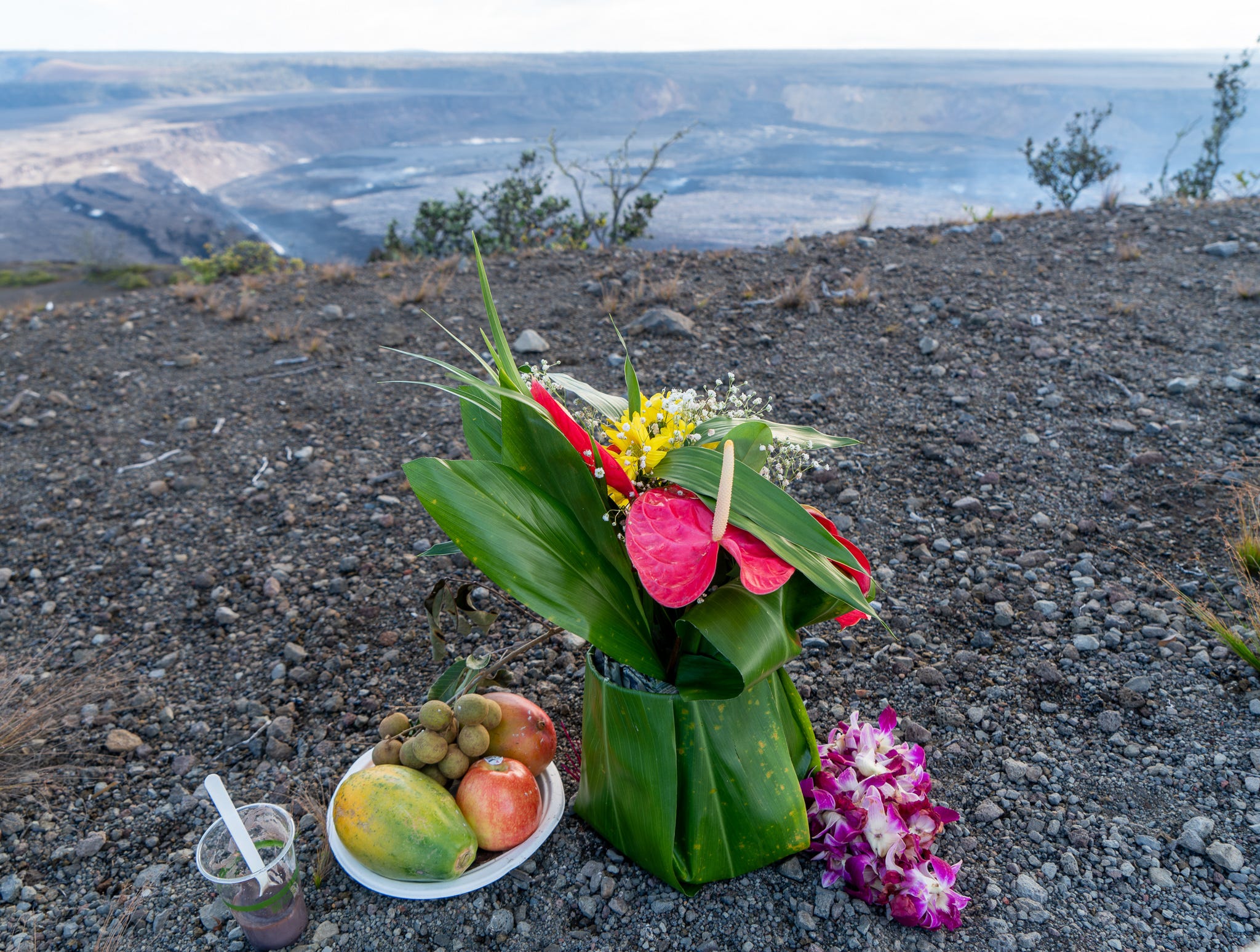
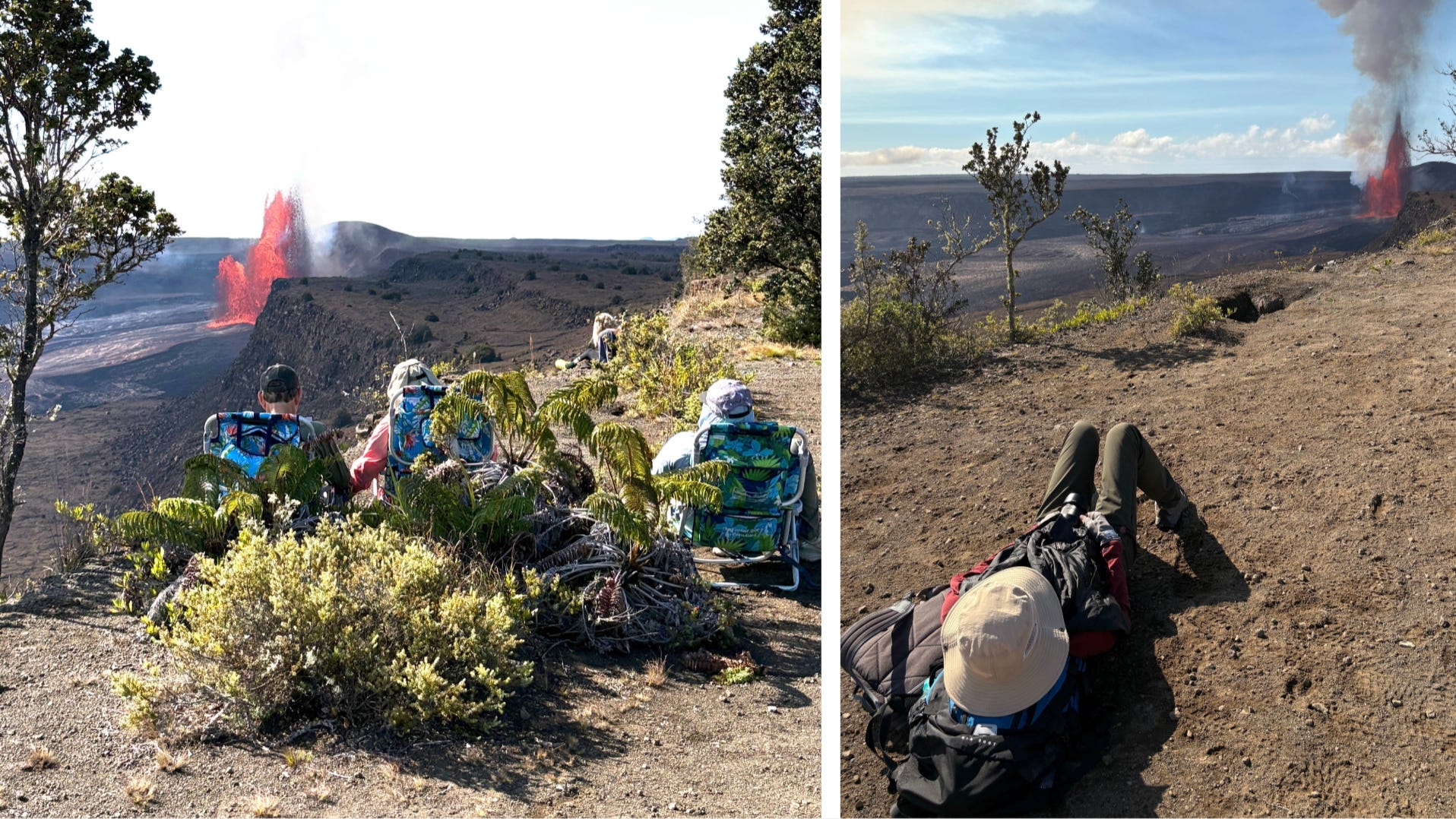
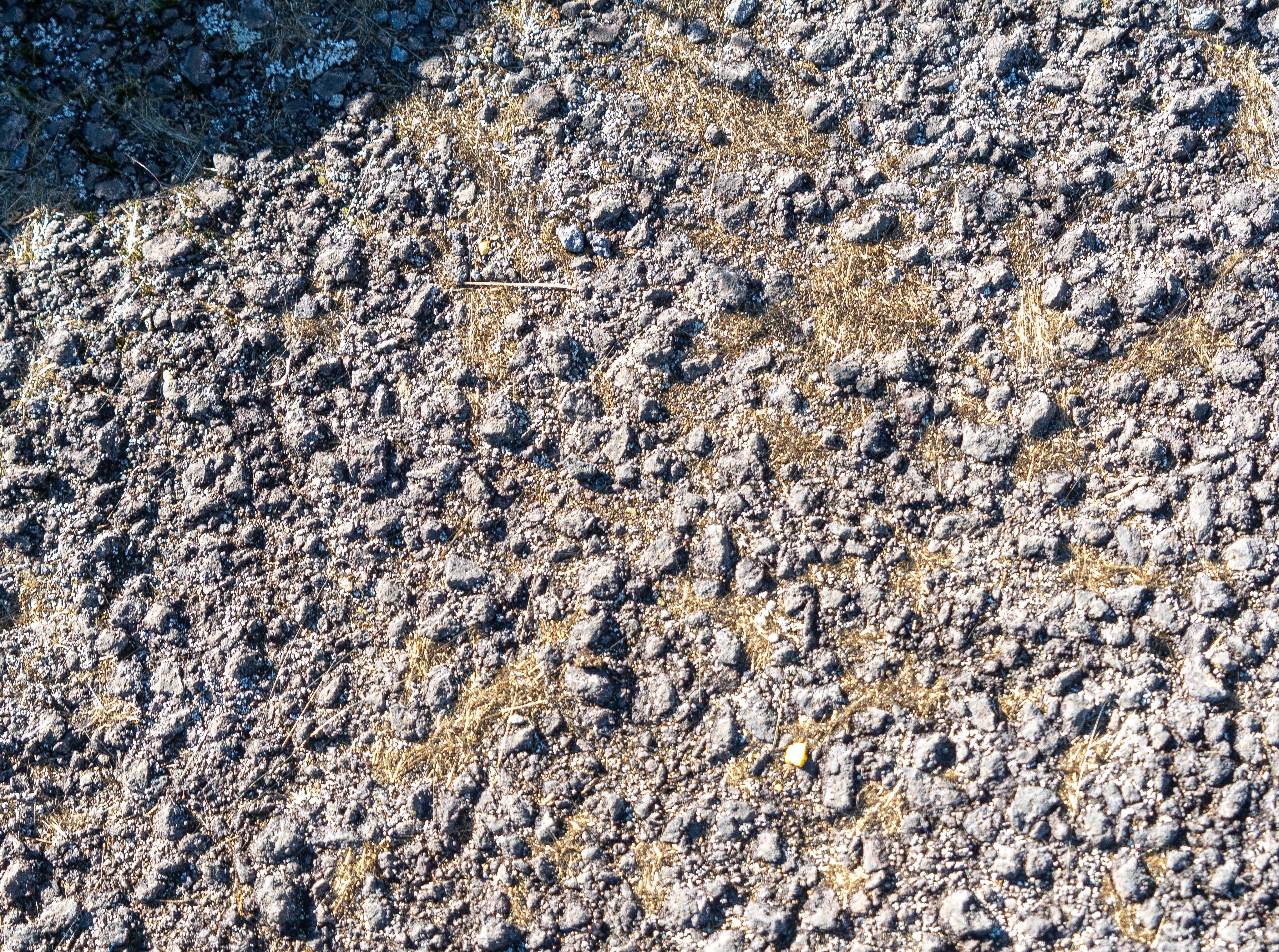
I will never forget the sights I saw that day. Offerings of food left by locals for Pele, wrapped in Ti leaves, her very favorite. The crimson of the magma as it jetted high into the sky, quickly cooling and turning into a shroud of cinder that fell back to Earth to twirl around the base of the fountain, where the unthinkable heat radiating from the magma stirred the air into twisters. Occasionally debris would rain down around us. The ejecta resembled stone but when you picked the pieces up they weighed almost nothing, crumbling in your fingers like glassy styrofoam. Baby rocks, I thought. Newborns. Perhaps because we’d visited a chocolate farm on our first day on the Big Island, they reminded me of giant cacao nibs. A volcano was erupting less than a mile from us, but the fact I was thinking about babies and candy shows you how safe we felt; we even spent stretches laying on the ground, watching through the Vs of our feet. When my husband took a bathroom break, he came back with a photo of a group who’d set up folding chairs and were having brunch, like a volcano picnic or tailgate party.
It was a day to remember. Later we learned that we were luckier than I’d thought. The winds were blowing away from us that day, protecting us from the majority of the debris raining down from the fountain of magma. When we finally returned to our car, we found it covered in glass fibers, spun out of the molten minerals spewing out far below, light enough to ride on the wind. The locals called it “Pele’s hair,” and if you’re downwind of a plume, the fine tubes can easily scratch and cut your skin.
Around six P.M., the fountain sputtered, then came to an abrupt halt, as though some invisible force had turned some invisible valve somewhere. We broke for dinner, then returned after nightfall.
Now all was quiet. The air was cool, crisp, stars innumerable filling the skies above with their light. This kind of crystalline night was something I’d experienced before, in the wilderness. But here was something I’d never seen: “stars” below, in a what appeared a virtual sea of incandescent magma, uncountable hot-spots twinkling in a crimson reflection of the Milky Way stretching overhead. There was no sound, only light, painting our faces in soft reds. Peering down at molten lava felt like something out of a dream. After the wild energies we’d seen unleashed during the day it felt gentle, even sleepy, Pele telling us the show’s over, time for bed.
Our Hawaiian friend who arranged my television appearance called us the “luckiest people.” she has lived in Hawaii her entire life, but never seen an eruption with her own eyes. I think we were even luckier than that, because we didn’t plan for this. We came to Hawaii for business. This side-trip had been a total extra.
At the end of the day, as I lined up for the lone bathroom in the lot where we parked, I struck up a conversation with an older woman. She pushed a cart with a tiny little white dog in it. She told me she that she was exhausted, because she’d spent the night before in her car, hoping to catch Kilauea in bloom. “But I had to do it,” she said. “I’ve lived here for fifty years. I’ve seen everything on this island, but never an eruption. What a day.” I agreed. “We are lucky!” were the last words we exchanged before parting.
Later, I learned, there is a story about the goddess Pele. Occasionally, they say, she transforms into an old lady with a white dog, blending in among us to testing our kindness. I don’t know if I met Pele that night. But if I did, I’m glad I told her how grateful I was, and how I’ll cherish the gift she gave me for the rest of my life.


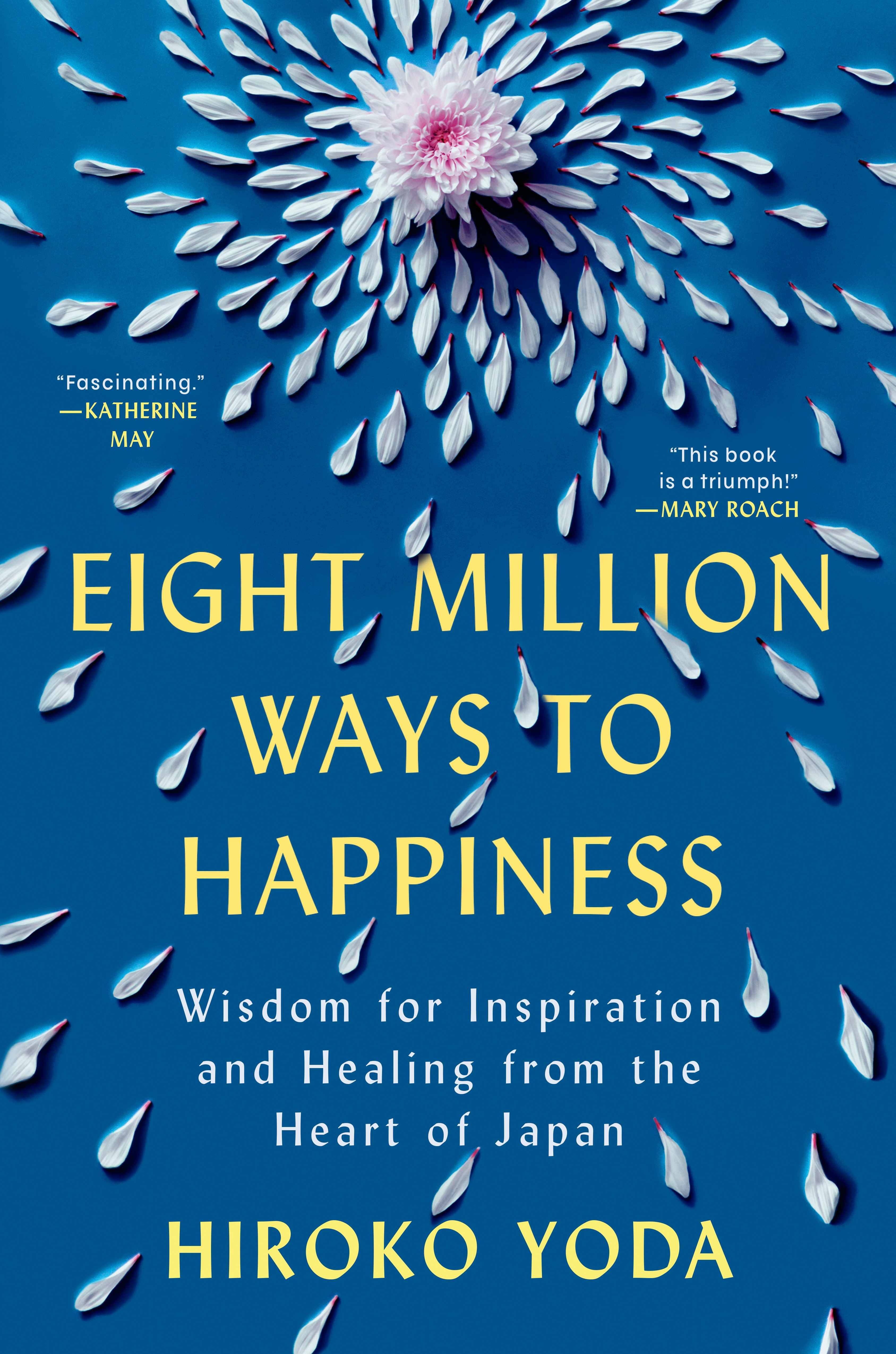
You can order Eight Million Ways to Happiness here! (Or here if you’re in the UK.)
What a wonderful experience. I lived in Hawaii for a few years, but unfortunately never made it to the Big Island and never experienced an eruption. Thanks for being kind to Pele!
Witnessing a volcanic eruption, and one that doesn't explode! A stroke of good luck indeed. And perhaps it augurs more good fortune for your new book.